
Here’s a heretical claim: if you’re launching technology in the AI era, indirection and strategic obfuscation are your best friends.
By strategic obfuscation, I do not mean obscurity or invisibility. The need for shameless self-promotion remains. Yet unlike in the past, it’s more important than ever to throw potential competitors off the scent, and perhaps to appear even a little misguided or overly simplistic. What I’m advocating for is deliberate geometric complexity—building something that resists the competitor comparison, that loses its value when you try to compress it into a category.
The conventional wisdom runs opposite to this: be clear, be direct, own your category, make it easy for people to understand what you do. That advice made sense when the primary threat was obscurity. It becomes suicidal when the threat is commoditization.
The Moat Problem
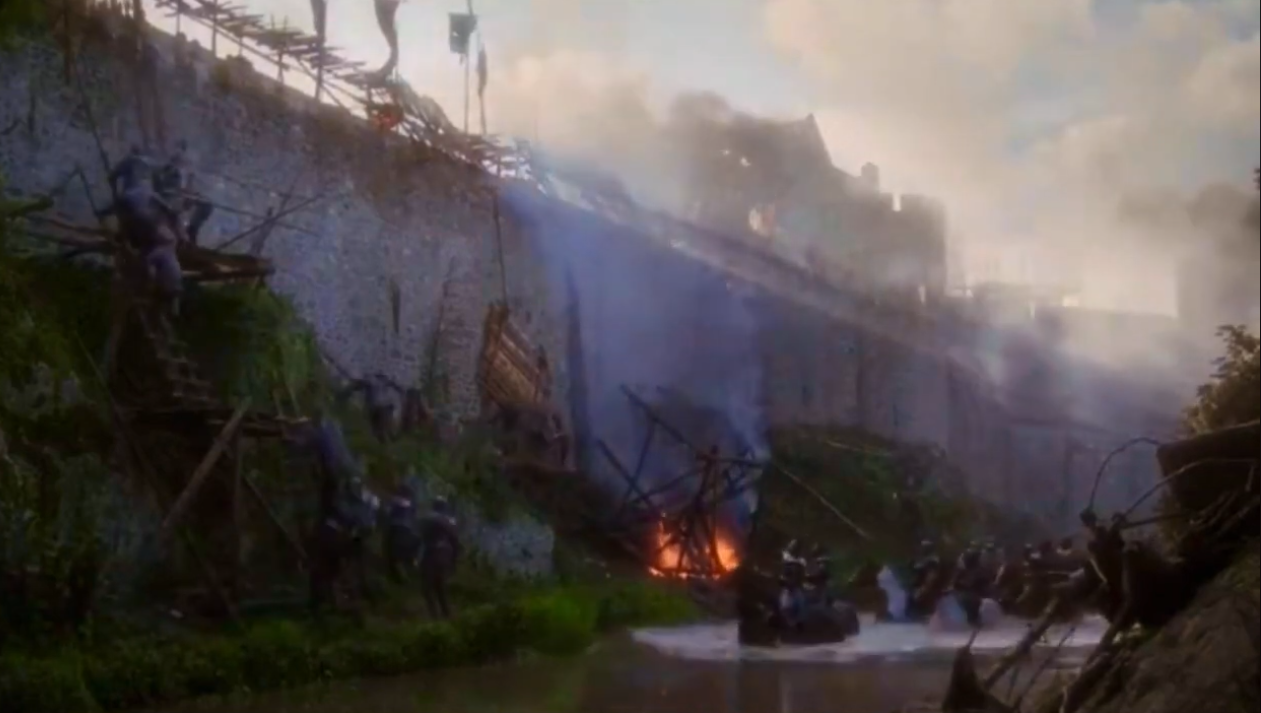
Everyone in tech talks about moats. VCs ask about them in every pitch, and startups dutifully brag about their data moats, their network effect moats, their switching cost moats. The entire vocabulary of competitive strategy remains stubbornly medieval: defend, protect, wall off, dig deeper.
The trouble is that moats are passive defenses. They assume the attacker will cross on your terms, that any siege will be slow, that you can simply wait them out.
AI does not siege your moat. It evaporates it. Your proprietary dataset is likely already in the training corpus, or something equivalent is. Network effects matter less when agents build their own context. Switching costs dissolve when an agent can translate between any interface.
And if you’ve made yourself easy to categorize—“oh, they’re the X for Y” or “they’re basically Z but for enterprises”—you’ve already told everyone, including the AI, exactly how to route around you.
1494
In 1494, Charles VIII of France crossed the Alps with 25,000 men and forty bronze cannons on horse-drawn carriages. Previous artillery was slow and clumsy. These were different—mobile, accurate, devastating.
The fortress of Monte San Giovanni had walls three and a half meters thick. It had withstood a siege of seven years. Charles took it in eight hours, then slaughtered the 700 inhabitants. It was a message: the old rules no longer applied.
Francesco Guicciardini, the Florentine historian, described the world before:
“Wars lasted a very long time, and battles ended with very few or no deaths.”
Then Charles:
“The French came upon all this like a sudden tempest which turns everything upside down… Wars became sudden and violent, conquering and capturing a state in less time than it used to take to occupy a village.”
The defensive paradigm that had worked for a thousand years was suddenly obsolete. And the Italian response wasn’t to build taller walls.
Geometry, Not Height
Within a generation, Italian engineers invented something new: the trace italienne. Instead of tall walls, they built low, thick ones. Angular bastions projected outward, eliminating blind spots.
The insight wasn’t about stopping cannonballs. You can’t stop a cannonball. The insight was about deflection—angled walls that bounced shots rather than absorbing them, interlocking fields of fire that made direct assault suicidal, geometry that turned the attacker’s strength into a liability.
Antonio da Sangallo the Younger built the Fortezza da Basso in Florence with massive earthen ramparts—not to resist impact, but to absorb it and render it pointless. Michelangelo designed Florence’s defenses around geometric precision for crossfire. Michele Sanmicheli made Verona into a system where every wall was defended by another.
The star fortress didn’t win by being stronger than cannons. It won by making cannons less decisive. Sieges became slow, grinding, expensive. The quick conquests of 1494 gave way to prolonged standoffs. The advantage shifted back to defenders—not through strength, but through indirection.
Palmanova, founded by Venice in 1593, was the logical endpoint: a nine-pointed star built from scratch, mathematically harmonious, every angle covered by another. It took 200 years to complete. UNESCO made it a World Heritage Site. It still stands.
The Geometry of Uncategorizable
Here’s what this means for launching technology now.
If an AI can easily categorize what you do, you’re already in a commoditization race. “They do X” invites someone else to do X, or for an AI to synthesize X, or for X to become a feature in a larger platform. You’ve defined yourself into a box, and the box has walls an AI can see right over.
The trace italienne defense is to be genuinely uncategorizable—not through vagueness, but through interconnection. Build something where the components don’t quite make sense in isolation, where understanding requires actual engagement, where any summary necessarily loses the value.
This is not, I should emphasize, a marketing trick. You cannot fake complexity. If you say confusing things but your product is simple, people will figure that out soon enough. The geometry has to be real.
What Real Geometry Looks Like
Consider what we do at Noosphere. We write about Deleuze and Guattari’s rhizomatic structures in the context of cryptographic trust infrastructure, and we connect continental philosophy to protocol design. We publish pieces that tie C2PA provenance to SLSA supply chain security to Cedar policy engines.
Now try to summarize that into a competitor comparison. Try telling an AI “they’re like X.” The concepts resist compression because the connections are the point—understanding one piece requires understanding how it fits with the others.
This is not obfuscation for its own sake. The ideas are genuinely interconnected. Rhizomatic trust actually does inform how we think about decentralized verification. The philosophy is not decoration; it’s architecture.
But here’s the key: even if someone mapped all the ideas, they couldn’t extract the value by copying the pieces. The geometry is the product. The interconnection is the moat that isn’t a moat.
Indirection as Launch Strategy
Standard launch advice goes something like this: be clear about what you do, own a category, make the value proposition obvious. This works well enough when the primary risk is that people won’t understand you. It fails catastrophically when the risk is that they’ll understand you too well.
In the AI era, being easily understood means being easily replicated—not by humans copying your code, but by the entire market converging on your now-obvious position. You’ve told everyone where the value is. You’ve drawn the map to your own fortress.
Indirection means something different: let them wonder a bit. Let the first reaction be “what are these people actually doing?” Build for the people who dig in rather than the people who skim.
This ends up filtering for the right customers, the right partners, the right investors. Anyone who needs a simple story probably isn’t going to be able to work with you anyway. The complexity is a feature precisely because it selects for depth.
The Cost
Star fortresses were expensive. They required engineers, mathematicians, decades of construction. Venice had to pardon criminals to populate Palmanova. Not everyone could afford the new geometry.
Strategic complexity is expensive too—you cannot simply bolt it on. The interconnections have to be real, which means building real things that actually connect. It takes longer, and it’s harder to explain to investors who want a clean narrative. It filters out people who would otherwise join.
The city-states that thrived after 1494 weren’t the ones who built the fastest or cheapest. They were the ones who understood that the game had changed and committed to the new geometry—Florence, Venice, the Papal States. The ones who kept building medieval walls became subjects of the ones who didn’t.
The Cannon Is Here
AI is the cannon. The quick victories are already happening—entire categories commoditized, business models evaporating, competitive advantages that used to last years now eroding in months.
The moats are drying up, and building taller walls will not help.
The defense is geometry and indirection. Genuine complexity that doesn’t reduce. Being uncategorizable not because you’re hiding, but because what you’ve built only makes sense as a system.
Time to redesign the fortress.
We’re building trust infrastructure for the age of AI—provenance, verification, and identity systems designed for a world where content flows through machines before it reaches humans. If you’re thinking about these problems, let’s talk.